[kml_flashembed movie=”http://www.ScottDickerson.com/blog/photos/aerial-photos-super-cub-mtns/loader.swf” height=”404″ width=”450″ base=”http://www.ScottDickerson.com/blog/photos/aerial-photos-super-cub-mtns/” /]
(Flash slideshow should load above, visit the online version if you don’t see it in your reader/email.)
Aerial photos of a legendary Alaskan Bush plane, the Piper Super Cub, in a classic Alaskan setting.
Last week I was treated to an aerial photo shoot by two pilot friends. We flew across Kachemak Bay from our hometown of Homer to spend thirty minutes flying amongst the dramatic mountain peaks and ice fields making up the Kenai Mountain Range. I’m always shocked by the majestic beauty of this mountain range that is just a ten minute flight from my house.
The weather conditions were ideal allowing us to make the most of the few short hours of sunlight we get this time of year, and topping it off was the company of a rising moon.
Aerial and air-to-air photos are certainly some of my favorite images to make. Something about the challenges of the quickly changing subject matter, the feverish search for the next fleeting moment of divine composition, the cold wind in my face, the entirely different perspective, the technical challenges of making a good photograph in these conditions. . . this is the kind of landscape photography that an outdoor adventure photographer can appreciate.
Some technical details for those of you that are interested – all the shots in the slideshow above were taken with a Canon 1D mark II digital SLR using a Canon 70-200 2.8L IS zoom lens. I typically shoot in manual exposure mode, occasionally aperture priority to give me the fastest shutter speed possible with my chosen ISO speed and aperture. I usually have the aperture at its smallest number in an effort to get the fastest shutter I can without pushing the ISO up too high. This day we had bright sunshine and a white plane on snow, this allowed for comfortable shutter speeds at ISO 250 and even allowed me to keep a slightly smaller aperture (5.6-6.3) giving me a little better depth of field. Looking over the EXIF data for a few of the shots I see I was shooting between 1/1,250th of a second to 1/5,000th.
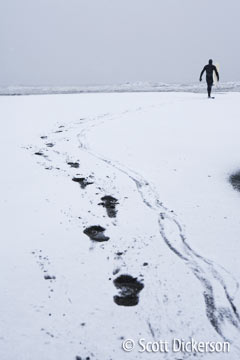 Standing out on the snow covered beach yesterday looking for the surfers I was there to photograph I had time to think about how strange it was. There I am in a near white out, the normally dark grey beach is white with fresh snow, looking out towards the rumbling surf I can barely make out the surfers in their black wetsuits. The sky was dark with heavy snow clouds, the waves were still messy from a nearby storm. Every once in a while I’d look back up the beach towards the cars and another black shape with a big white object would emerge from the greyness heading my way, every patch of skin covered up except a little red face. The surf wasn’t really very good, but after a slow fall season there were a handful of eager Alaskan surfers out there trying to see the sets coming through the blowing snow.
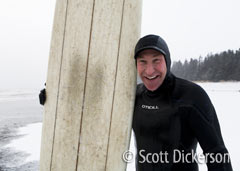 It is incredibly inspiring and enjoyable to photograph unique subjects like this. Standing out there stomping my feet to keep the blood flowing I couldn’t stop smiling thinking about it, surfers and a snowstorm, what a contrast. Though winter is our surf season, it’s not that often that we get the pleasure of surfing during a heavy snow. I was glad to be able to get out and photograph in the few short hours we had before the sun dipped back below the mountains.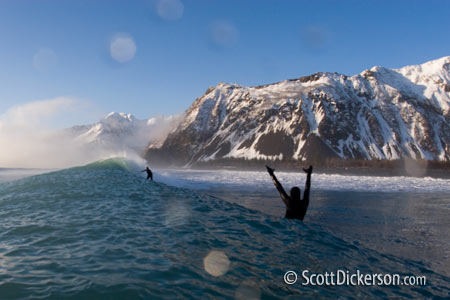
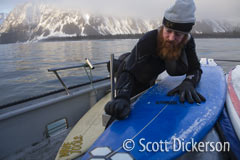 That’s what someone is said to have when they do curious things in the dark and cold of winter. Normal things would include carrying wood from the woodpile to the fireplace, talking to your friends about how stupid ‘The Deadliest Catch’ is, but how you watch it anyways, or spending all the money you made commercial fishing on espresso beans to keep you from hibernating. If you happen to be up late at night on one of those long winter nights keeping the fire going and see your neighbor stumble from his house at 5am in a skin tight black suit carrying what looks like a silver body bag you can safely assume he’s off to do some self medication for his cabin fever. Off to Bear Glacier, which is at least a three hour drive and a 45minute boat ride from anywhere, unless you live in Seward, Alaska.
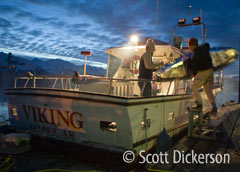 Last winter a few of the local surf crowd headed to the glacier for a real alaskan winter surf experience. We left home at 5am so we could be waiting at the boat when Capt. Scott showed up at first light. After pouring a couple gallons of antifreeze coolant in the right main we where on our way, all wondering if the engine was actually going to need any ‘coolant’ with the air temps far below freezing.
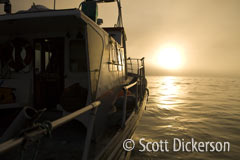 As we approached Bear Glacier we were engulfed in a golden fog, and greeted with a decent 3-5ft swell rolling in from the Gulf of Alaska. Everyone suited up and jumped in the water as if they had mistaken Bear Glacier for a coral reef in indonesia. I was thinking about that science experiment when I learned that salt water can be below 32F and still not freeze. I guess I should have just been thankful we were surrounded by saltwater allowing us to use our surfboards instead of ice skates. After five months of refrigeration, the water in Resurrection Bay was cold.
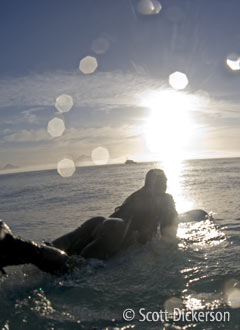 Looking at the back side of the waves peeling along in nice rights I had to remind myself that this was a business trip, the surfing could come after the photos. If I would have known then that camera focus issues were going to make 99% of the shots useless, I would have happily left the camera behind and went for a good sloshing in the super cold cycle. However, I needed to learn this lesson, the one about taping the focus ring to keep it from shifting. The lesson was certainly burned into my memory when I returned home and looked at all those smiling faces with incredible snow capped mountains in the background. I think they were smiling anyway; mostly they were just black blobs in a sea of green with a background of white and blue. I clearly remember thinking how incredible these shots were going to be as I happily snapped away, consoling my aching desire to surf by promises of becoming rich and famous from these photos. As chance would have it, a few of the photos taken in the surfhousing did turn out, but I’m still waiting for the rich and famous stuff.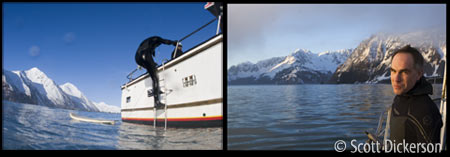
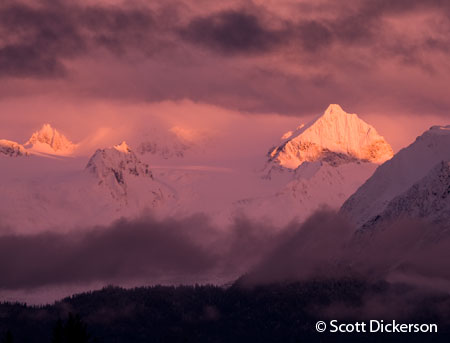
 On the second day a friend, who knows me well, called with an alert to the unfolding magic outside. He called because in his own words – “I figured you were working on your computer.” That nonsense ended quickly. I ran outside and set up a still camera (canon 20D) on the porch with an interval timer instructing it to shoot a time laps sequence. Then I scurried up the hill behind my house to shoot the sunset from a better perspective than my porch offers. I often find myself in a situation of mild panic when the light is perfect out. Quick! quick! The light might be gone in 5 minutes. This must be what it’s like to practice triage in a medical emergency. You might only have ten minutes. Photo opportunities are dying left and right. You must do something, but what? You can’t do it all. In this case I went for a quick setup on the time laps camera. Putting it on the porch where the view isn’t the best but it still looked promising. Then I moved to a better view point to frame images shooting normal stills. I could have shot a better time laps, but it would have cost me in the variety of stills I was able to shoot.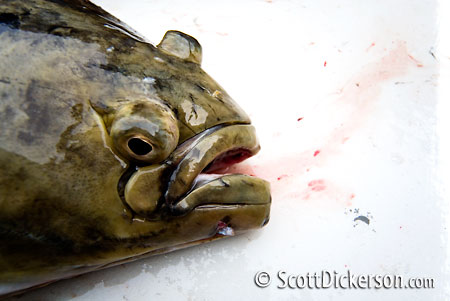
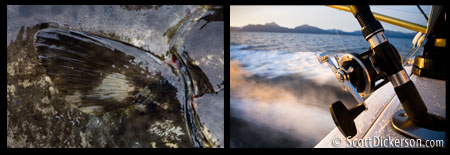
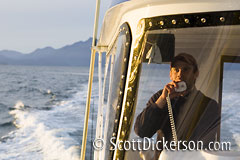 This freelance photographer took the wise words of advice and made plans; plans to do something lively with the subject of killing fish. They say if you want to do it right, get professional help. Fortunately, I have several friends who have made it their profession to catch halibut by operating fishing charters out of Homer. This connection made organizing this photo shoot a cinch. In September I spent a day out on lovely Kachemak Bay with David Bayes, captain of the ‘Grand Aleutian’ and owner of
 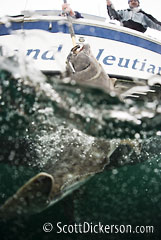 The goal of this photo shoot was the same as basically every other assignment– take an old subject that has been photographed a thousand times and make it look new and exciting. The shot that I dreamed up was a split view perspective (half under water, half above) with a big halibut being pulled out of the water onto the fishing boat framed by the dark depths of the ocean below and the smiling faces of the thrilled fisherman above. I have a ‘surf housing’ in my gear closet that I use to photograph those crazies