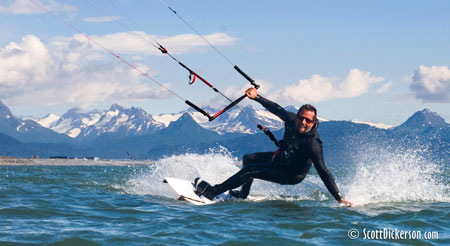
“Did you see those guys parachuting with waterskis?! Or where they kayaking with a hang glider?â€
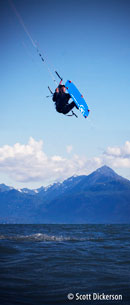 Kitesurfing is a real attention getter, rubbernecker and comment generator. The first time I saw someone kitesurfing a few years ago I didn’t know what to say either, I just knew I wanted to find someone to blurt out some excited nonsense to: “I saw this guy and he was doing this thing on the water with a parasail and ripping super fast and flying up in the air spinning and then I don’t know what else but it looked incredible.â€
It may have become commonplace in many coastal towns in America by now, but when kitesurfers are spotted in Alaska they still arouse outbursts of excitement. Lots of people in my hometown have surprised me with descriptions of UFO’s seen last weekend when they were walking their dog on the beach. I usually have the pleasure of asking them if they saw the little floating head with the big camera in the water as well. So far I seem to go mostly unnoticed, or they don’t hear my question because they are talking over me trying to explain this crazy thing they saw.
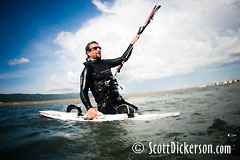 So what is kitesurfing? Basically it’s flying a huge kite that is so powerful that it can drag you around, up, and down. The kite has 4 lines attached allowing you to control its flight, it has a ‘control bar’ which you steer with, and it attaches to a harness you wear that. The surfing part happens when you get out on the water and stand on your board which is a cross between a wakeboard and a surfboard. The kite then drags you to and fro, lifting you off the water when you fly it certain ‘zones’ above you. This tangle of lines and fabric, which easily fits in a backpack, launched into a 15 mph wind will amaze anyone with its Hummer like horsepower. One of the greatest and most magical things about kitesurfing is this incredible power available without the consumption of fossil fuels; a non-motorized sport that can thrill even a diehard motorhead. Kiting brings a whole other level of excitement with it’s reliance on wind, especially when you sense that maybe your not in total control of the situation- similar to riding in your girlfriend’s car when the roads are icy.
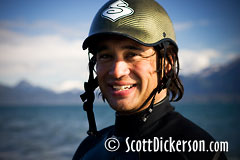 These photos were taken in Homer, Alaska; where every sunny summer day brings a daybreeze onshore creating ideal kitesurfing conditions. A growing number of the locals have started making the most of this setting, allowing me some good opportunities to shoot Alaskan kitesurfing photos. We have been discussing plans to pioneer a few of the countless ‘unkited’ locations around Alaska, so stay tuned for trip reports from the Kite Alaska team. If you are interested in getting involved post a comment below.
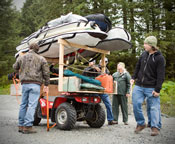 Some creative thinking brought about a plan to send Iceman’s four wheeler down to Yakutat on the Alaska marine highway ferry with our 12 surfboards. The 10 of us would follow along a week later in the jet. This worked out great, saving us hundreds of dollars in excess baggage charges and as a major bonus we had a beach buggy waiting for us in Yakutat. Iceman put his carpentry to work and slammed together an African-safari style rack for the wheeler that made it possible to put all those boards on the poor thing and still drive it onto the ferry.We were very excited when we found the four wheeler in Yakutat still upright despite it’s top heaviness from all our surfboards on the surf-safari rack.
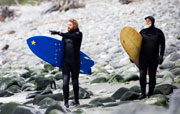 We later learned that notoriously rainy Yakutat had actually broken a rainfall record the day before our arrival. The next couple hours were spent trying to find dry wood for a fire, before we finally gave up and used the four wheeler gas instead. With our domestic chores out of the way, we scrambled into our wetsuits, waxed our surfboards, and headed for the water.
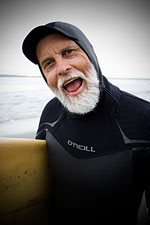 So began a four day surfing marathon. I am still in shock at the amount of surfing a few mid-fifty year old diehards can do. Of course, they may credit it to the handfuls of anti-inflammatories they would eat for desert each night, but pills and whiskey aside, that was still astounding feat of surfing dedication. There must be something about Alaskan surfers and the challenges that they must overcome to surf the last frontier that drives them to another level of addiction. I used my photography excuse to take rest breaks on several occasions while my surfing buddies/models just kept going, and going, and then it would get too dark to photograph, and they are still surfing. This is really saying something during an Alaskan summer where the sun doesn’t even set until after 10pm.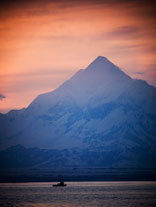
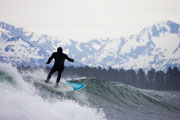 For most of us, this was our first surfing trip to Yakutat, but I doubt it will be the last. Everyone had a great time, and I don’t think I’m alone looking forward to the next time the phone rings and Iceman says Pack your bags, Surf trip to Yakutat- Yahooo!
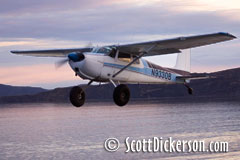 For the last three years I have been joining a fish spotter friend, Brad Heil, on a two-week adventure out to Bristol Bay in the Bering Sea. We pack our camping gear (and my photography gear) into Brad’s Cessna 175 bush plane and take off from the Homer airport heading West out across Cook Inlet, over the active volcanoes in the Alaska Range, along the shoreline of Illiamna Lake, over the twisting rivers that drain down into Bristol bay, and along the coast line to the Northwest corner of Bristol Bay. Togiak Bay, and it’s neighboring bays are our home for a couple weeks, tent-camping on the beach and spending the days flying around this wild bit of the earth.
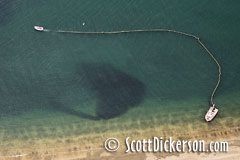 Brad’s job is to tell the fisherman where the schools of herring are and direct them when setting their nets around the fish. My job during the Togiak herring fishery is to prevent us from having a mid-air collision with other spotter planes flying in circles above the boats. But, we all know the real reason I’m there. If I have to help Brad dodge other airplanes to stay alive, I’ll do it, but mostly I’m obsessed with shooting aerial photos.
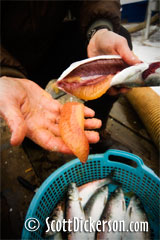 For those unfamiliar with Alaska’s commercial herring sac roe fisheries, I will try and explain the basics. In the spring millions of pacific herring come to the Togiak bay area from somewhere out in the depths of the Bering Sea. They come to spawn in the shallow waters in and around Togiak Bay which is in the Northwest edge of Bristol Bay. The female herring develop large egg sacs in their bellies prior to spawning, and some people (mostly Japanese) like to take these eggs and put them in their own bellies. This photo at left shows Brad holding an egg sac taken from a Togiak herring.
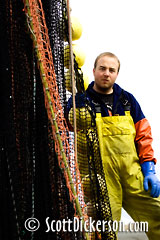 The fishermen use boats called seiners to catch the fish. The boats are named as such because they use seines (type of net). The fishermen do their best with the help of their spotter pilot to wrap their seine (net) around a school of herring. Once they have the fish in their net the tender (bigger boat with large storage capacity) sends a skiff over to scoop out a sample of the herring which are analyzed to determine the percentage of the fish that are females with ‘ripe’ roe in them. If this number is not high enough the fish processing company will not buy the fish so the fisherman must let them go.
 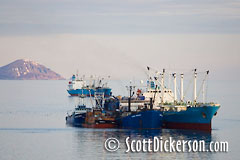 If the percentage is good then the tender boat comes alongside the fishing boat and uses a pump to move the fish from the net into big refrigerated water tanks on the tender. A good set in the Togiak fishery can be as big as 800,000lbs of herring. The fish are chilled on board the tender as they are taken to a floating processor where the roe is extracted, packaged, and frozen before being loaded ontos very larger tramper vessel that will deliver the roe to markets in Japan.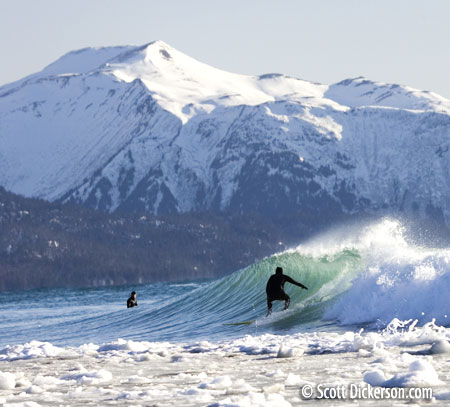
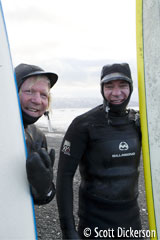 One of the best things about surfing in Alaska is the great spirit out on the water. Some would say it’s because misery loves company. Whatever it is, we make quick friendships sitting out there in the water, freezing together as we wait for that perfect swell. It might be just because there are so few of us that we band together due to a preservation instinct. I think there is also an element that comes when you are in the water shaking with hypothermia, you definitely hope that anyone around is your friend, and will help you get out of your wetsuit if you are too cold to open the zipper yourself. We still call each other when the waves are firing, and try desperately to get at least one other person to share the experience with us. I must say though, I’ve heard rumors of crowds in one surfing spot in southeast Alaska.
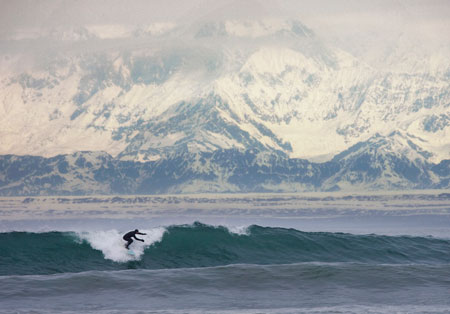
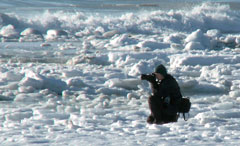 For a few winters I’ve been throwing the camera in the car on my way to the beach, and until last winter that’s mostly where it stayed. It’s difficult to surf and photograph on the same trip to the beach. If I go surfing first, then my hands are numb, my body shaking, and the only thing on my mind is a hot shower. If I photograph first, then I get too cold standing on the beach and the last thing I want to do when I’m that cold is jump in the water. So needless to say, a lot of amazing surf sessions passed undocumented. This last winter though, I just couldn’t stand it anymore. I was finding myself out in the water on picture perfect days wishing I was on the beach with the camera. It can just be so overwhelmingly dramatic surfing here sometimes that I had to do something about it. So this winter I started leaving the surfboard on the car and just photographing. I think it paid off, though I missed some great waves, I’ve got photos to show how nice they were. And I’ve got some happy surfing buddies. Sure they missed my company in the water, but nobody minds seeing a photo of themselves getting barreled outside the ice pack with snow covered mountains in the background. (Thanks to Donna Rae Faulkner for the photo of me photographing surfers on the icy beach)
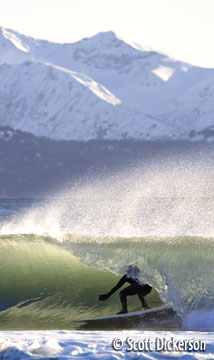 This last winter offered some great surfing photo opportunities with lot’s of ice on the beaches and some really nice waves. I spent most of the best surf days standing on the beach bundled up wearing a fur hat with holding frozen cameras. These photo shoots are not particularly technically challenging, it is mostly about being there at the right time and knowing the subject. The photographic challenges mostly involve keeping the cameras warm enough to operate and having enough batteries to make it through a good session. Mostly when I’m photographing surfing in Alaska I try to focus on what makes this special. People are surfing gorgeous green waves the world-round, so what makes Alaska so special? I try and show those elements that make surfing in Alaska unique – ice, snow covered mountains, snowy beaches, uncrowded breaks . . .
 The day of the third opening, Ken Jones allowed me to ride along on his boat, F/V Agave, for a couple test fishing sets in the morning. A sample of the fish caught were analyzed by Fish and Game to determine the ‘maturity’ of the eggs in the female herring. Shortly after the test sets were finished it was announced that there would be a fishery that day. Tom Stafford, captain of the F/V Infinite Glory, let me spend the opener on his boat photographing from up in the rigging and running around on deck.